Budapest uses the same electrical standards (220 volts, 50 hz) and plugs (schuko) as much of Western Europe, with the outlets having two round holes. Grounded outlets are recessed and near-universal; rarely, you may find ungrounded, flush outlets (though never in our apartments).
Here is what one of the sockets in the apartment looks like:
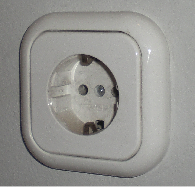
For visitors from the USA, In the USA we use 110volts and 60 HZ. This means that the voltage and the plugs in Budapest are different from at home. See the Before Leaving Home section below.
For those from the UK voltage at home is 240v and 50 HZ. That means the voltage is essentially the same in Budapest but the plugs are different. If you are coming to Budapest with electrical/electronic gadgets from home, all you will need are adapters for the European plugs.
For the rest of the world, you have to figure it out for yourself because I don’t know what you have at home… http://www.powerstream.com/cv.htm
If you are traveling from a country like the USA with a different voltage standard and different outlets/plugs, here is what you need to know to operate any gizmos you happen to have brought along and feel are essential to the quality of your life (note that we provide hair dryers, a hot water kettle, a coffee maker, etc):
BEFORE LEAVING HOME (USA): SO the first thing to do, before you do anything else, is ascertain what voltage your gizmo needs, and use a converter if, and only if, you have to modify the voltage. Take everything you plan to bring along with you and sort it into three heaps: (1) electronic doodads with universal (110-240v 50/60Hz) power supplies; (2) electronic doodads with 110-120 volt power supplies, and (3) electrical doodads with substantial wattage and 110-120 voltage. Label them or do something to keep them straight.
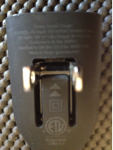
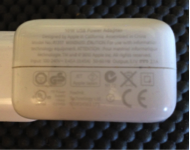
(1) Universal power supplies. Many small electronic devices (phones, most cameras, most laptops, iPads, iPods…) work with 110-240 volts. Those are very flexible doodads. All power supplies for laptops, mobile phones, PDAs, iPods, and the like tell you somewhere on them (sometimes in very tiny type and sometimes it’s just in raised letters in very, very tiny type, black on black, but it’s there) how many volts (input) and how many watts (input) the device requires. For instance, the unreadable stuff embossed on this plug:
or the tiny print here:
 or the relatively clear information here: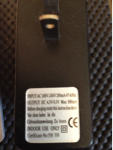
the electrical specifications are always there, but their visibility ranges from the clear to the near- undetectable; squint and persevere…it’s important!
If your device will accept 220 Volts USE AN ADAPTER (if you need to) to change the plug to make it fit into the receptacles in the apartment. DO NOT USE A CONVERTER, which may well get confused (or confuse your gizmo), causing it to overheat, melt, give off toxic fumes, and otherwise act in an anti- social manner. In Europe, use a 220 outlet for these devices. See The Big Picture below if you are the sort of person who only believes things when they have been told the reason why.
(2) Small electronics with 110-120 power supplies. Some manufacturers still, stupidly, provide power supplies specific to the country the item is purchased in. If you are traveling with anything that specifies 110-120 volts, only plug it into something that provides that voltage. You may or may not need an adapter to do so.
(3) Electrical appliance that require more than 5 watts. Hair dryers, water heaters, curling irons, laser printers, x-ray machines, space heaters, portable electric chairs … and other things that may sometimes make the lights dim momentarily when you are at home, these all use more power than most converters can handle. If you plug one of these into a converter you will likely blow a circuit breaker and possibly start a fire. Please try to avoid doing that. Even if yours operates on 220-240 volts as well as 110-120, recognize that it may overtax the circuit breaker if you plug it into the wall. I would rely on what is already in the apartment, or if you feel it is essential to use only the specific curling iron that your hair is intimately familiar with and willing to perform for, make sure you are not also using the a/c or the washer or the dryer or the stove.
IN THE APARTMENT — THE BIG PICTURE:
In order get electricity out of the wall and into your gizmo there are two, separate, requirements: the voltage needs to be acceptable to your gizmo (if it is not, you will likely fry the gizmo and, perhaps, set fire to your loved ones); and, separately, the plug from your gizmo somehow has to fit the receptacle on the wall. These two requirements are dealt with either separately (voltage conversion is done by a CONVERTER that ‘steps down’ the 220 volts to 110; making the plug fit the holes is done by an ADAPTER) or together (because sometimes, converters also function as adapters; adapters never function as converters).
HERE IS THE BIG DANGER IN CONFUSING CONVERTERS AND ADAPTERS: It is possible, using an adapter without a converter, to make your gizmo’s plug fit into the wall without changing the voltage. If you do that and your gizmo requires 110 volts, it’s bye-bye gizmo. If, on the other hand, you have a gizmo that works with both 110 and 220, and you plug it into a step-down converter, the chip in your gizmo that decides whether it is getting 110 or 220 will get confused and anxious and frustrated, causing it to heat up and potentially fry the gizmo (and perhaps those standing nearby). I think this is because of the difference in HZ, which converters do not convert, but I am far from sure if this is the reason…just trust me, THIS IS A BAD THING TO DO: IF YOUR DEVICE ACCEPTS 110-220 (or 110-240) PLUG ITN INTO WHATEVER IS COMING OUT OF THE WALL; do NOT convert it. Just use an adapter if necessary.
IN THE APARTMENT – WHAT WE PROVIDE;
You will find stashed somewhere a rather comprehensive set of adapters, and you probably won’t need any of them? Why? Because we also provide two power strips, each clearly marked.
One is white and accepts only US-style plugs. It is connected to a converter and provides 110-120 power for devices that require 110-120 and cannot operate on 220-240: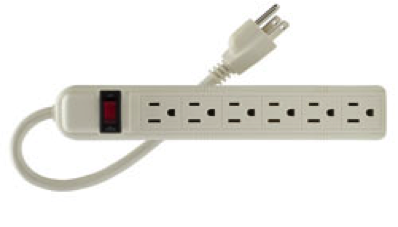
The other is black and provides 220-240, and here’s the cool part: it accepts all plugs (pretty much; certainly US, UK, and European ones, but also some others), so it requires no adapter. Google ‘Wonpro’ to find out about exactly what you can plug into it: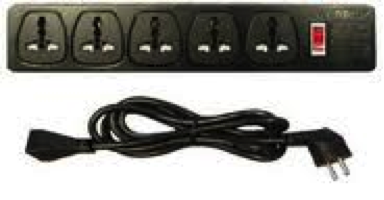
But we also provide adapters, and a converter or two, in case there aren’t enough holes in the power strip or you want it elsewhere in the apartment. Specifically, you should find a couple of Wonpro universal adapters (and we strongly recommend these if you’re going to buy a travel adapter for general use elsewhere; they’re great, solid, and relatively inexpensive from a variety of vendors on Amazon: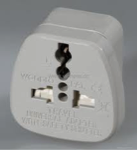
And also several chargers, including: (1) a European connector for Apple’s iPad ‘iPod/computer charger brick;
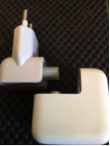 (2) a white USB charger that works on European voltage and has European plugs and accepts any cable with a normal USB (male) plug at one end (this includes iPhones and many cables that allow you to charge your mobile phone from a computer); this charger is not powerful enough to charge an iPad;
 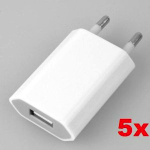 (3) European wall chargers for devices that have a mini-USB
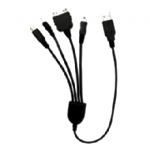 and (4) a micro-USB connector (Most Blackberry phones use one or the other, and in fact almost all newer phones will accept one of these); and (5) a hydra-headed USB connector cable that should work with almost any device imaginable that accepts 5-5.1 volts input from its charger:
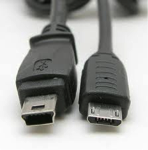
So you should be pretty well covered for adapters. The big heave black things are converters, and they typically are not powerful enough to convert more than 5 watts.